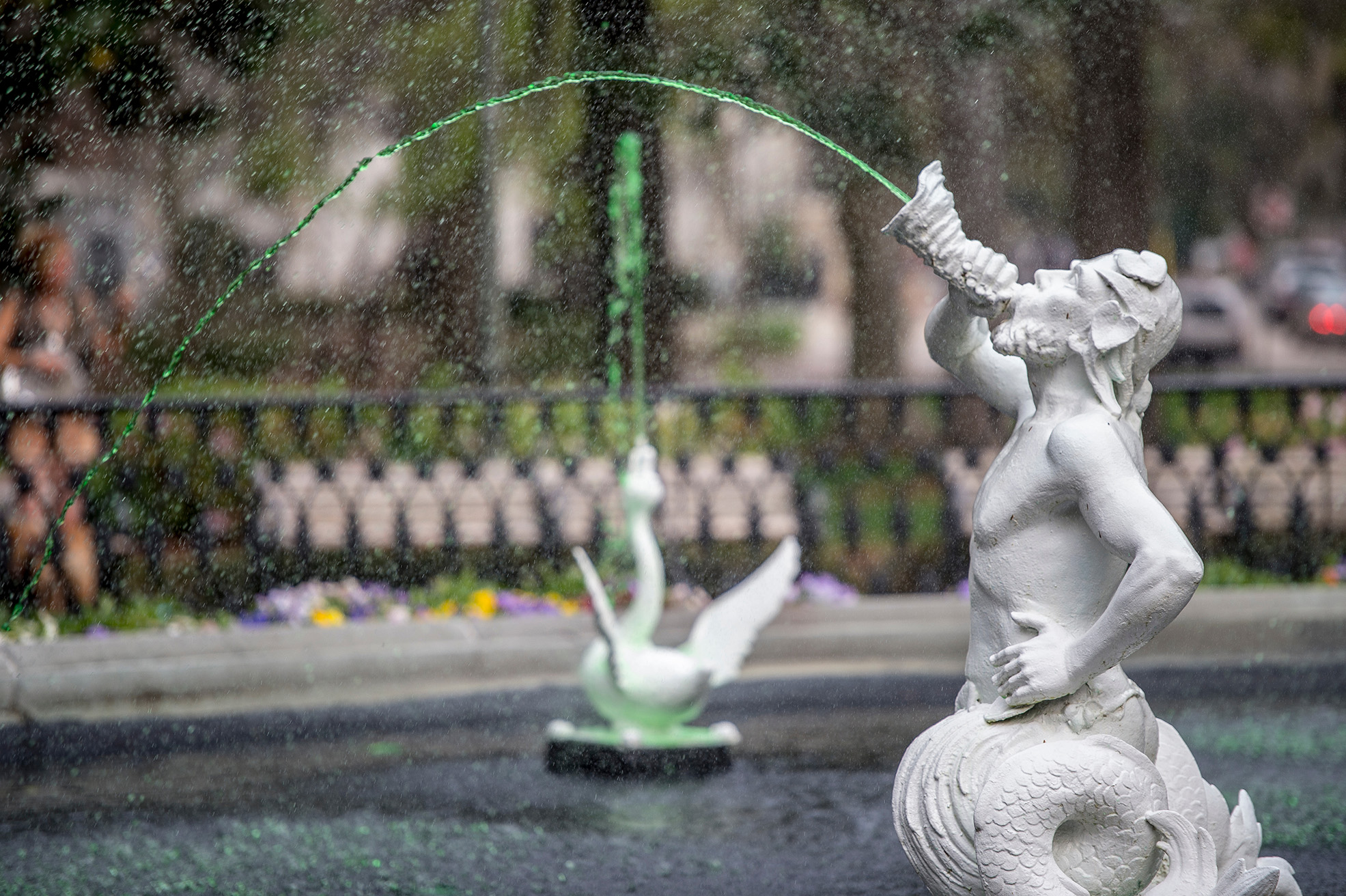
Savannah’s St. Patrick’s Day season officially gets underway today with the annual greening of the Forsyth Park fountain, one of the city’s most recognizable traditions leading up to the parade. Each year the water is dyed bright green, marking the start of celebrations that will soon draw hundreds of thousands of visitors to the city. But Savannah’s ties to Ireland go far beyond the festivities. The Irish have been part of the city’s foundation for centuries, and their influence has helped shape neighborhoods, culture, and traditions that still define Savannah today.
The first Irish settlers arrived in Savannah in 1734, just a year after the colony was founded. Some came in search of land, others for religious freedom. By the early 1800s, Irish immigrants were arriving in much larger numbers, working in the growing city’s shipyards, railroads, and construction projects. When the Great Irish Famine struck in the 1840s, the flood of immigration only grew, with thousands more making their way to Savannah, particularly from County Wexford. By 1860, research suggests that as many as one in three white households in the city had at least one Irish-born resident.
The first public St. Patrick’s Day celebration in Savannah took place in 1824. Organized by the Hibernian Society, a local group dedicated to supporting Irish immigrants, the event began as a simple procession to Mass. Over time, it grew into something much bigger. By the late 1800s, the parade had become a major city event, with a grand marshal leading the way, floats and bands filling the streets, and thousands turning out to watch. The traditions expanded, and today, Savannah’s St. Patrick’s Day season includes a series of ceremonies, gatherings, and celebrations leading up to the big day.
The city’s Irish roots are still evident today, even beyond the holiday. The Celtic Cross in Emmet Park honors the early Irish immigrants who helped build Savannah, and the city remains home to a number of Irish organizations that continue to celebrate and preserve the heritage. The connection between Savannah and Ireland also extends beyond history—Georgia Southern University even has a campus in Wexford, strengthening the long-standing link.
While other cities with large Irish populations saw immigration slow over time, Savannah’s Irish community remained strong for generations. The annual St. Patrick’s Day celebration is a reflection of that, evolving from a religious observance into a massive citywide tradition. What started as a small gathering nearly two centuries ago has turned into one of the most recognizable St. Patrick’s Day celebrations in the country, and for many in Savannah, it’s more than just a party—it’s a way of honoring the city’s past.