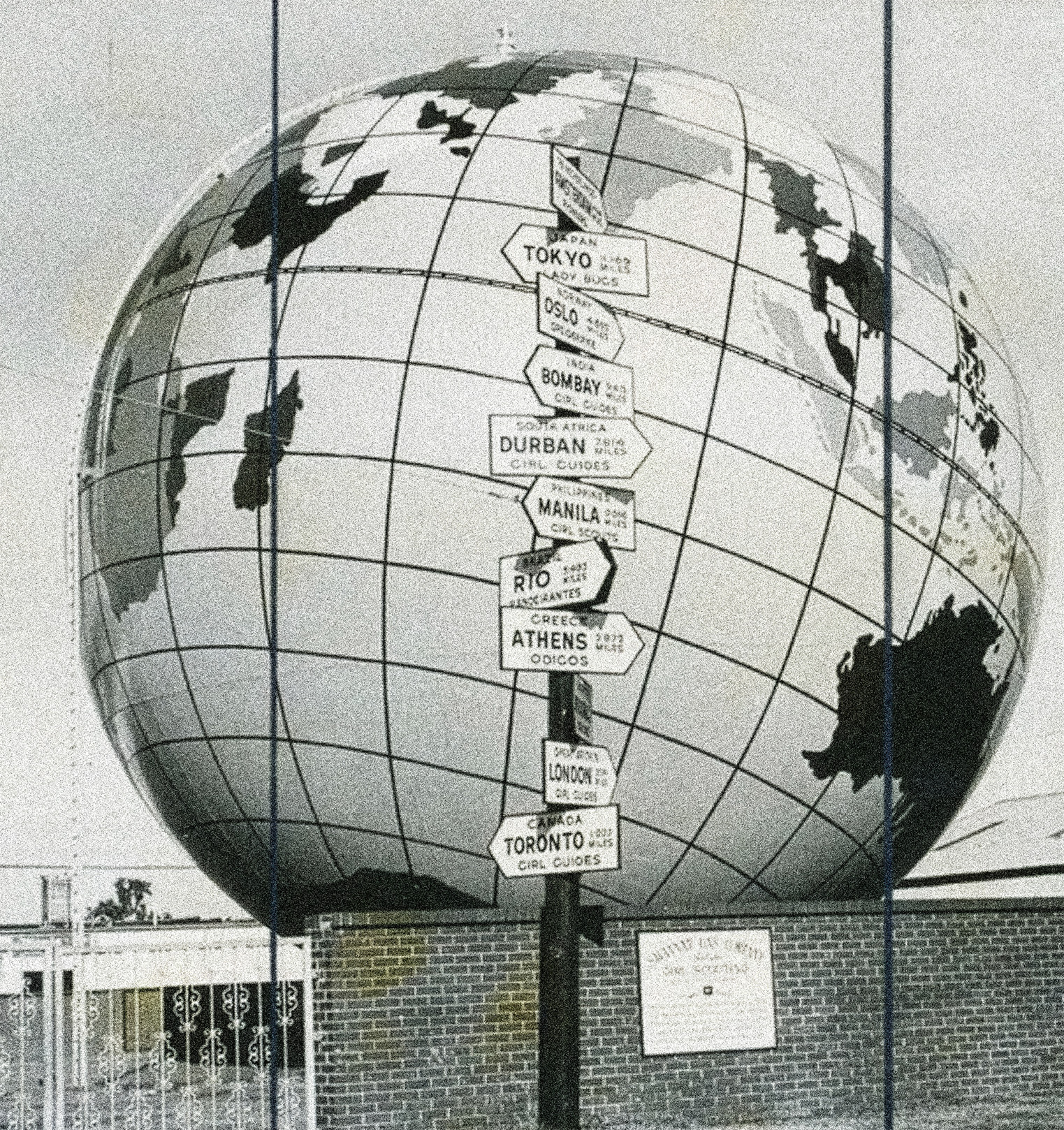
There's something wonderfully absurd about driving around the entire planet just to pick up your morning coffee. Yet that's exactly what many Savannahians do every day at the intersection of White Bluff Road and DeRenne Avenue, where a sixty foot steel sphere painted to resemble Earth has watched over the city since the late 1950s. But this isn't just another roadside attraction. The Savannah Globe tells the story of a city reinventing itself, a story told in layers of paint, hurricane winds, and one spectacularly botched meteorological detail.
When the Savannah Gas Company erected this Hortonsphere in 1956 and 1957, they weren't building a tourist attraction. They were constructing critical infrastructure, a pressurized vessel capable of holding 600,000 cubic feet of natural gas at 75 pounds per square inch. Post-war Savannah was expanding rapidly, and the gas company had spent over five million dollars installing more than 300 miles of new mains to keep pace with growth. The sphere represented confidence in the city's future, a steel promise that Savannah was becoming something bigger than it had been before.
Yet even then, someone recognized that utility could also be spectacle. The structure was christened "The World's Largest World" and painted by James Ellison and Leo Berkemeier of Turner Outdoor Advertising to resemble a classroom globe, with countries rendered in different colors and one proud label: SAVANNAH. By the time Christmas 1957 rolled around, Santa and his sleigh appeared perched atop this new landmark, headed straight for the Hostess City. The company president, H. Hansell Hillyer, even brought a Girl Scout troop from Winder, Georgia to receive a geography lesson in front of it. This wasn't infrastructure meant to hide. This was infrastructure meant to teach, to inspire, to make people look up and wonder.
For kids growing up in the nearby Groveland subdivision during the 1960s, the globe anchored an entire world of possibility. The surrounding Globe Shopping Center offered everything a child with a bicycle and a quarter could want: Ted Henkle's Music Shop with its Billboard 100 list and listening counter, a bowling alley, a trampoline and miniature golf course owned by tourism pioneer Herb Traub, and a drive-in restaurant called The Globe where seagulls feasted on leftover curb service. The sphere stopped storing gas in the 1970s, but it had already transcended its original purpose. It belonged to the city now.
In 1998, Ohio muralist Eric Henn transformed the globe from a geopolitical map into something more evocative: Earth as seen from space, continents and oceans swirling in blues and greens. And because this was 1999 Savannah, just after Hurricane Floyd had threatened the coast before turning away at the last moment, Henn painted the storm onto his globe as a kind of memorial. There was just one problem. He painted it spinning the wrong way. Clockwise instead of counterclockwise, backwards for a hurricane in the Northern Hemisphere. The error went unnoticed by most, but Henn never forgot it. Twenty-four years later, when he returned to repaint the sphere, he double and triple checked the rotation of Hurricane Fran, the storm he chose this time around.
That return in 2023 almost didn't happen. By 2021, the globe had deteriorated into what Greg Parker, founder and CEO of Parker's Kitchen, called "an eyesore." When his company purchased the 3.4 acre site for redevelopment, demolition would have been simpler than restoration. But Alderman Nick Palumbo pressed the case for preservation, and Parker listened. The company invested over $100,000 in engineering studies, repainting, and a special UV-resistant, graffiti-proof coating for the 500,000-pound structure. More remarkably, they designed the new Starbucks so its drive-through lane circles the globe itself. You literally drive around the world to get your latte.
The globe has witnessed other orbits too. Twenty three years ago, Roger Burdette climbed to its summit in a Superman costume, cape whipping in the wind, and proposed to his girlfriend Karima from the top. Every time they drive past now with their children, they have a story to tell. That's what landmarks do. They give us places to anchor our narratives, to measure how far we've come and where we've been.
The 1999 film Forces of Nature captured the globe in its original atlas incarnation, a last glimpse before Henn's space age transformation. The sphere appears briefly in a story about chaos, detours, and the unexpected routes we take. It's fitting. The globe itself has been all those things: industrial necessity turned civic symbol, threatened landmark turned preserved treasure, wrong way hurricane turned running joke. It has survived redevelopment, neglect, and the temptation to make room for something more practical.
Standing at that busy intersection today, the globe reminds us that Savannah has always been a city that saves things, that sees value in the odd and the ordinary made extraordinary. The sphere sits on ground once walked by James Oglethorpe, later occupied by Fort Wayne, transformed into industrial gasworks, and now reborn as coffee-fueled commerce. Every layer tells a story. Every coat of paint preserves a memory. And somewhere on that painted surface, just offshore from the coast, a hurricane spins the right way at last.